noindex).Hip osteoarthritis: symptoms, grades and management
Hip osteoarthritis is wear of the cartilage in the joint between the femur and the pelvis. It usually starts with groin pain and stiffness when getting up, and progresses slowly.
Educational information prepared by Dr. Belinda Martínez, physician and surgeon (University of Guadalajara), professional license 10900033. Last updated: October 4, 2026.
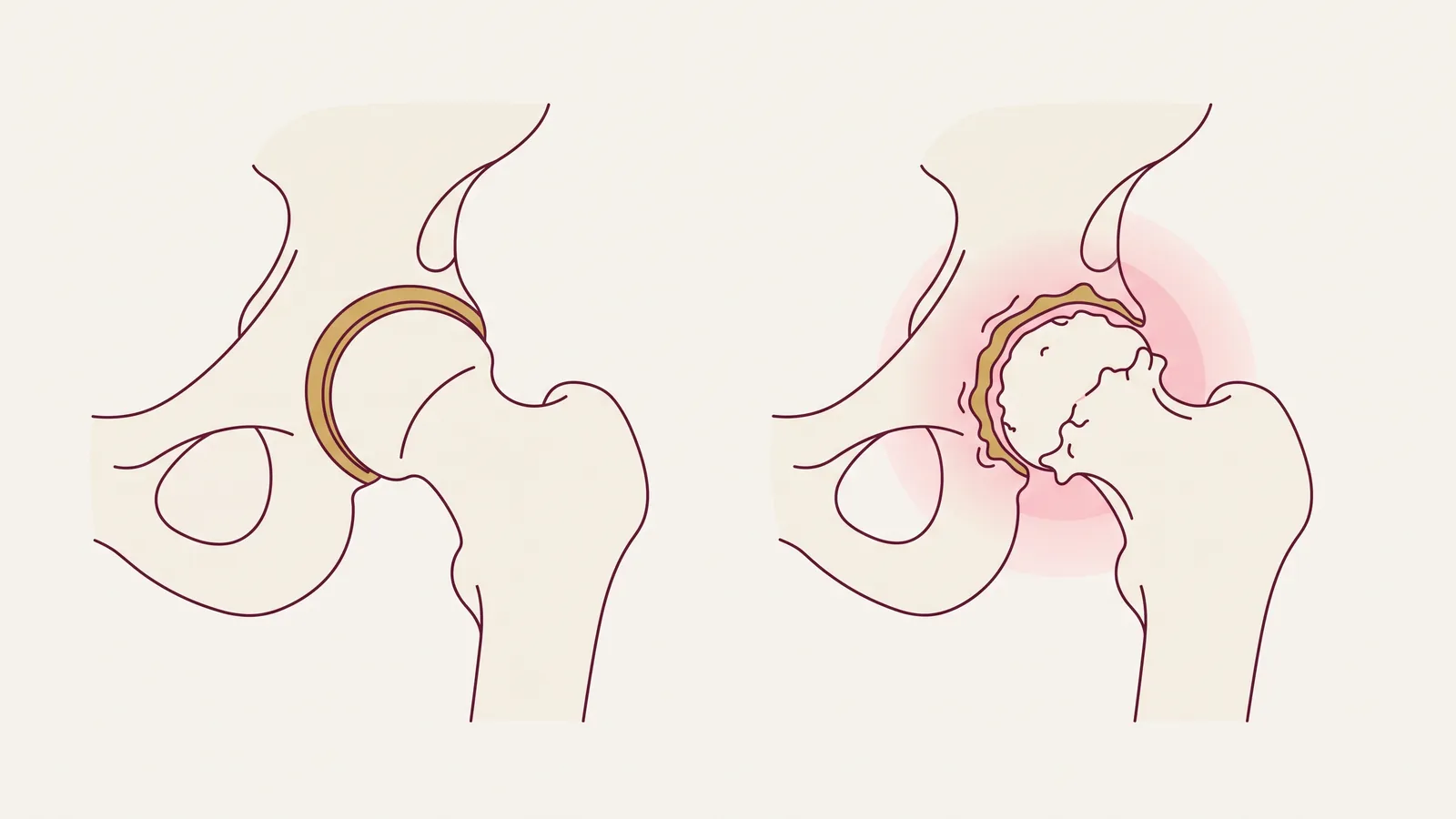
What is hip osteoarthritis?
The head of the femur fits into a socket in the pelvis called the acetabulum. Both surfaces are covered with cartilage. In osteoarthritis that cartilage thins and the bone underneath reacts, causing pain and loss of movement. It can affect one hip or both (bilateral).
It is more common after 50, but appears earlier when there are changes in the shape of the hip, previous injuries or overload.
Early symptoms and where it hurts
- Pain in the groin, which can travel down the front of the thigh to the knee.
- Stiffness when getting up in the morning or after sitting.
- Difficulty putting on socks, cutting toenails or crossing the legs.
- Limping or needing to rest when walking long distances.
Pain at the back or side of the hip often does not come from the joint but from the lower back, the buttock muscles or bursitis. That is why an assessment is worth it before assuming it is osteoarthritis.
How it is diagnosed and what grades exist
Diagnosis is based on the symptoms, the exam (especially hip rotation) and a pelvic X-ray. The X-ray shows narrowing of the joint space and other changes, and is usually graded from 0 to 4. As with the knee, the grade on the image does not always match the intensity of the pain.
Management options: without and with surgery
- Adapted exercise and strengthening of the glutes and thigh, guided by a physical therapist.
- Weight control to reduce the load on the joint.
- A cane in the hand opposite the painful hip, if it helps you walk.
- Pain medication only as prescribed by a doctor.
- Image-guided injections in selected cases.
- Hip replacement when wear is advanced and pain limits daily life despite non-surgical treatment.
Biological therapies are also being studied for hip osteoarthritis. In the assessment we see whether any of them makes sense in your case.
When to see a doctor
Seek medical care soon if you have any of these signs:
- Severe hip pain after a fall, especially in older people (it may be a fracture).
- You cannot put weight on the leg, or the leg is turned or shorter.
- Hip pain with fever or a warm area.
- Pain that does not ease with rest and keeps waking you at night.
Frequently asked questions
Can hip osteoarthritis be managed without surgery?
Yes, in many people. Exercise, weight control and pain management allow an active life for years. Replacement is considered when these measures are no longer enough.
Why does my groin hurt if the problem is the hip?
The hip joint sits deep, at the level of the groin. That is why osteoarthritis pain is felt there rather than on the side or the back.
Does walking make hip osteoarthritis worse?
In general, no. Walking at a comfortable pace and strengthening the muscles helps. Avoid what causes severe pain and ask for an adapted exercise plan.
Book your free assessment
Bring your tests and your questions. The assessment is by video call, free and with no commitment.
Book a free assessmentOsteoarthritis: how we assess it →Keep reading
This content is informational. To find out what applies to your case, book your free assessment with the doctor.